
The Best Way to Combine Listening, Speaking, and Reading
574 views
Learning a language can feel strangely unbalanced.
You spend weeks reading articles, yet freeze during a simple conversation. You listen to podcasts every morning but still struggle to build your own sentences. Or maybe you've memorized hundreds of vocabulary words, only to forget them when someone asks a basic question.
That frustration isn't usually caused by a lack of effort. It's caused by separating language skills that your brain naturally learns together.
After working with different learning methods—and making plenty of mistakes myself—the biggest improvement rarely came from studying longer. It came from connecting listening, speaking, and reading into a single practice cycle instead of treating them as separate tasks. That's how children acquire their first language, and modern research on second-language acquisition largely supports a similar approach for adults.
Your brain doesn't store language in separate folders
Reading teaches recognition.
Listening develops sound recognition and pronunciation patterns.
Speaking forces active recall.
Miss one of those pieces and progress slows down.
Researchers such as Stephen Krashen have emphasized the value of understandable language input, while Merrill Swain's Output Hypothesis argues that producing language helps learners notice gaps in their knowledge. More recent cognitive science research on retrieval practice reaches a similar conclusion: recalling information strengthens long-term memory more effectively than repeated passive review.
Those ideas aren't competing theories. They fit together remarkably well.
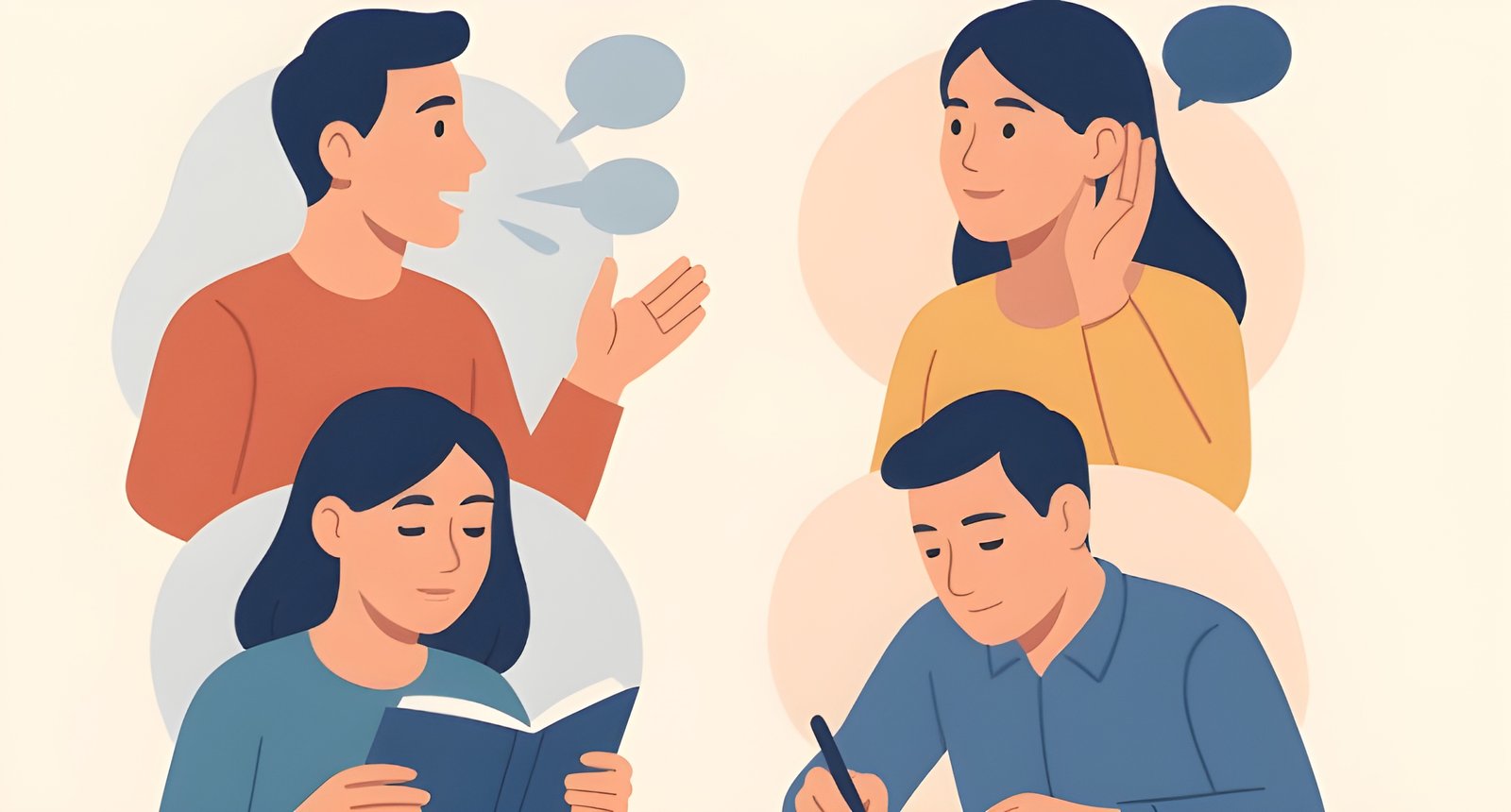
Think of language as a three-part loop rather than three independent skills.
Read something.
Hear it.
Say it.
Repeat.
Simple. Surprisingly effective.
Why studying one skill alone usually hits a wall
Many learners become excellent readers but hesitant speakers.
Others spend hours watching Netflix in their target language without understanding enough to improve significantly.
I've seen both patterns countless times.
Passive exposure feels productive because you're spending time with the language. Yet your brain isn't being challenged to retrieve words, adjust pronunciation, or build sentences under pressure.
Reading alone has another hidden limitation.
Written language often differs from everyday conversation.
English is a perfect example.
A news article might say:
"The committee postponed the proposal pending further review."
Most native speakers would simply say:
"They decided to wait."
Different vocabulary. Different rhythm.
That's why combining multiple language activities produces stronger results than mastering one in isolation.
The three-step learning loop that actually sticks
Forget marathon study sessions.
Aim for twenty to thirty focused minutes instead.
Step 1: Read first
Choose material slightly above your comfort level.
Not impossible.
Just challenging enough that you understand around 90–95% of the content.
Good examples include:
Graded readers
News articles written for language learners
Children's novels
Blog posts on topics you already enjoy
Don't stop for every unknown word.
Highlight unfamiliar vocabulary and keep moving.
Constant dictionary lookups interrupt comprehension and reduce reading flow.
Step 2: Listen to the same content
Now switch formats.
Many learning platforms include synchronized audio. Others don't.
Fortunately, several tools make this easier today:
Tool | Useful Feature |
|---|---|
LingQ | Imports articles with synchronized audio and vocabulary tracking |
Readlang | Instant translation while reading web pages |
Audible | Professional narration for many books |
Spotify Podcasts | Variable playback speed from 0.5× to 3× on supported podcasts |
YouTube | Automatic captions plus manual playback speed adjustment |
If you're using YouTube, manually reviewing subtitles is worthwhile because automatically generated captions occasionally misinterpret names, accents, or fast speech.
You'll probably notice something interesting.
Words that looked familiar suddenly sound completely different.
That's normal.
English spelling alone creates countless surprises—think though, through, tough, and thought.
Don't chase perfect pronunciation
Speak immediately after listening.
Not tomorrow.
Right now.
This technique is often called shadowing, popularized by language educator Alexander Arguelles.
Here's the process:
Listen to one sentence.
Pause.
Repeat it aloud.
Compare your pronunciation with the original.
Don't worry about sounding perfect.
You're training your mouth as much as your memory.
Many learners whisper because they're afraid of making mistakes.
Ironically, speaking quietly usually makes pronunciation less accurate.
Use a natural speaking voice instead.
Why repeating the same material isn't boring
At first it feels repetitive.
Then something changes.
The second reading becomes easier.
Listening suddenly sounds clearer.
Speaking requires less mental effort.
That's not boredom.
That's your brain reducing cognitive load.
Educational psychologists sometimes describe this as building automaticity—performing familiar tasks with less conscious effort because repeated exposure has strengthened neural pathways.
Progress often feels invisible until one day you realize you understood an entire conversation without translating every sentence in your head.
Mix difficulty levels during the week
Many learners accidentally choose material that's either far too easy or impossibly difficult.
Neither extreme works well.
A practical weekly balance looks like this:
Difficulty | Purpose | Percentage |
|---|---|---|
Easy review | Build confidence and speed | 40% |
Moderate challenge | Expand vocabulary naturally | 45% |
Difficult content | Stretch comprehension | 15% |
That final category shouldn't dominate your study time.
Watching a legal drama full of courtroom terminology during your second month of learning? Probably not the best investment.
Technology can help—if you use it wisely
Language apps have improved dramatically.
Still, they're tools.
Not magic.
Several platforms now combine reading, listening, and speaking into a single workflow.
For example:
Duolingo includes speaking exercises using automatic speech recognition.
Babbel focuses more heavily on dialogue and pronunciation practice.
LingQ tracks known vocabulary across imported lessons.
Language Reactor, a browser extension for Chrome-based browsers, adds dual subtitles, vocabulary saving, and replay controls for supported Netflix and YouTube content.
Speech recognition deserves one warning.
Even in 2026, automated pronunciation scoring isn't perfect.
Background noise, regional accents, low-quality microphones, and internet latency can all affect accuracy.
I've seen learners repeatedly marked incorrect despite producing understandable pronunciation.
Treat these scores as feedback—not absolute truth.
Build conversations from what you read
Reading shouldn't end with the last page.
Turn it into speech.
Suppose you read an article about climate change.
Instead of closing it immediately, ask yourself:
What was the main point?
Which arguments did I agree with?
How would I explain this to a friend?
Speak your answers aloud.
No script.
No memorization.
Those small conversations with yourself create retrieval practice that textbooks rarely provide.
It feels awkward at first.
Then it becomes surprisingly natural.
One small habit changes everything
Keep a "reuse notebook."
Not a vocabulary notebook.
There's a difference.
Instead of collecting isolated words, write down complete phrases you genuinely expect to use.
Examples:
"I hadn't thought about that."
"That depends on the situation."
"Could you explain that again?"
"I'm still getting used to it."
Native speakers rely heavily on ready-made phrases rather than assembling every sentence from scratch.
Learning chunks speeds up speaking far more than memorizing random word lists.
Common mistakes that quietly slow progress
Some problems don't seem serious until months later.
Here are a few worth avoiding:
Reading without ever saying words aloud.
Listening only with subtitles in your native language.
Memorizing vocabulary alphabetically instead of learning it in context.
Jumping between five different apps every week.
Studying for three hours on Sunday, then skipping the rest of the week.
Consistency beats intensity almost every time.
Fifteen focused minutes every day usually produces better long-term retention than occasional marathon sessions.
Measuring progress without obsessing over fluency
Forget counting vocabulary words.
Instead, ask practical questions.
Can you understand a podcast that felt impossible last month?
Can you summarize a short article without reading it again?
Can you hold a two-minute conversation without translating every sentence?
Those milestones matter more than maintaining a perfect streak in an app.
Language ability is ultimately measured by communication—not statistics.
Frequently Asked Questions
Is listening more important than reading?
Neither should replace the other. Listening develops comprehension of real speech, while reading expands vocabulary and reinforces grammar. Together they create stronger retention than either skill alone.
Should I read aloud while learning?
Yes, especially during beginner and intermediate stages. Reading aloud strengthens pronunciation, improves rhythm, and helps connect written words with spoken language.
How much speaking practice do I need each day?
Even 10–15 minutes of active speaking can make a noticeable difference if you're consistently recalling vocabulary instead of reading from a script.
Are subtitles helpful?
Yes—but start with subtitles in your target language whenever possible. Native-language subtitles often shift attention away from listening and toward translation.
What's the best order: listening, speaking, or reading?
A practical sequence is reading first, listening to the same material second, and speaking about it immediately afterward. That progression reinforces comprehension, pronunciation, and active recall in a single study session.
Turn every lesson into a conversation
The biggest breakthrough usually isn't finding a better textbook or downloading another app. It's refusing to let any piece of language stay passive. Read something worth understanding. Listen until the rhythm becomes familiar. Then speak—even if the first attempt feels clumsy. Repeat that cycle consistently for a few weeks, and you'll likely notice something unexpected: language starts feeling less like information you're studying and more like something you're actually using.
balanced learning
language skills
study method
Found this helpful? Share it!