
20 Business Idioms You Need for Professional Communication
432 views
Ever sat through a meeting where someone says, "Let's circle back," "We need to move the needle," or "This project is on the back burner," and everyone else nods while you're quietly wondering what just happened?
It happens more often than people admit. Business English isn't just about grammar or vocabulary. It's packed with idioms that native speakers use in emails, Zoom meetings, Microsoft Teams chats, Slack conversations, LinkedIn messages, and even customer presentations. Miss the meaning, and the conversation can feel like it's moving twice as fast as you are.
I've watched highly skilled professionals lose confidence simply because they interpreted an idiom literally. The good news? Once you recognize these expressions—and know when not to use them—they become surprisingly natural.
Why business idioms still matter
Artificial intelligence can draft emails. Grammarly Business can polish your writing. Microsoft Copilot and Google Gemini can even rewrite awkward sentences.
Yet none of these tools automatically teach you the subtle cultural meaning behind everyday workplace expressions.
A sentence like:
"Let's table this discussion."
means two completely different things depending on where you're working.
In American English, it usually means postpone the discussion.
In British parliamentary English, it traditionally means bring the topic forward for discussion.
That tiny difference has caused genuine confusion in international meetings for years.
Business idioms aren't grammar rules. They're shortcuts people use to communicate quickly.
20 business idioms professionals actually use
1. Think outside the box
Meaning: Develop creative solutions instead of relying on familiar ideas.
Example:
"The marketing campaign isn't working. We need to think outside the box."
Best used during brainstorming—not when discussing strict legal or compliance procedures.
2. Move the needle
Meaning: Create measurable improvement.
Example:
"Changing the logo won't move the needle. Improving customer retention probably will."
Managers often use this expression when discussing KPIs, quarterly targets, or analytics dashboards.
3. Circle back
Meaning: Return to the topic later.
Example:
"We're running out of time. Let's circle back tomorrow."
This phrase appears constantly in Zoom meetings and Teams calls.
4. On the same page
Meaning: Everyone shares the same understanding.
Example:
"Before we launch, let's make sure everyone is on the same page."
Simple. Effective.
5. Back to the drawing board
Meaning: Start over after something failed.
Example:
"The client rejected the proposal. It's back to the drawing board."
Nobody enjoys hearing this.
6. Raise the bar
Meaning: Increase quality or expectations.
Example:
"Our competitors improved their customer support. We need to raise the bar."
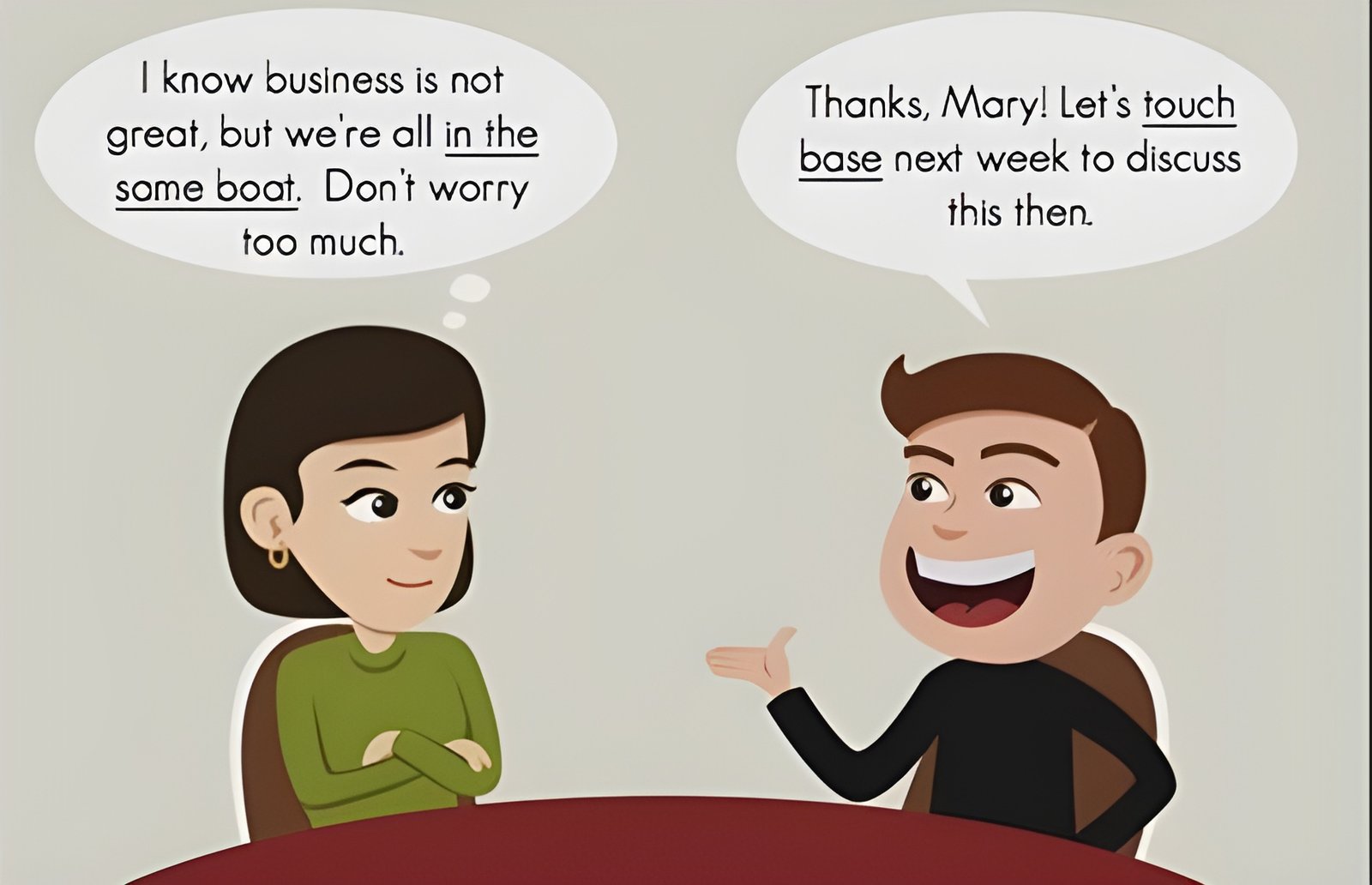
7. Touch base
Meaning: Make brief contact.
Example:
"I'll touch base with the design team after lunch."
It's common in email, although some professionals now prefer more direct wording like "I'll check with the team."
8. Low-hanging fruit
Meaning: Easy opportunities that require little effort.
Example:
"Let's fix the broken FAQ pages first. That's low-hanging fruit."
This often appears in SEO discussions because repairing broken internal links or updating outdated metadata can produce quick gains.
9. In the loop
Meaning: Included in ongoing communication.
Example:
"Please keep finance in the loop."
Slack channels and Microsoft Teams groups make this much easier than endless email chains.
10. Out of the loop
Meaning: Missing important information.
Example:
"I've been on vacation, so I'm completely out of the loop."
11. Hit the ground running
Meaning: Begin working immediately with little training.
Example:
"The new project manager hit the ground running."
Realistically, very few new employees actually do this. Most still need time to learn company workflows.
12. Ballpark figure
Meaning: A rough estimate.
Example:
"Can you give me a ballpark figure before we prepare the final quote?"
Clients appreciate estimates. They rarely appreciate pretending an estimate is exact.
13. Back burner
Meaning: Delay something temporarily.
Example:
"Let's put the website redesign on the back burner until Q4."
Many project management tools—including Jira, Asana, and Monday.com—essentially formalize this idea through backlog or deferred task lists.
14. Learn the ropes
Meaning: Understand how something works.
Example:
"Give the new employee a few weeks to learn the ropes."
15. Ahead of the curve
Meaning: More advanced than competitors.
Example:
"Companies adopting passkeys based on the FIDO2 authentication standard are staying ahead of the curve in account security."
Notice something? The idiom fits naturally because the example references an actual technology trend rather than vague innovation language.
16. Cut corners
Meaning: Save time or money by reducing quality.
Example:
"We shouldn't cut corners on cybersecurity testing."
Software teams discover this the hard way. Skipping code reviews or security audits might speed up one release, but the technical debt usually comes back.
17. Get the ball rolling
Meaning: Start a project or discussion.
Example:
"Let's get the ball rolling before the client meeting."
18. Put all your eggs in one basket
Meaning: Depend entirely on one option.
Example:
"Don't put all your eggs in one basket by relying on a single supplier."
The same advice applies to digital marketing. Businesses relying only on organic search traffic often struggle after major search algorithm updates.
19. Win-win
Meaning: A solution benefiting everyone involved.
Example:
"Flexible work hours became a win-win for employees and management."
Not every negotiation produces one. That's perfectly normal.
20. By the book
Meaning: Follow official procedures exactly.
Example:
"The finance department handled the audit by the book."
Industries with regulatory requirements—banking, healthcare, aviation, and government contracting—hear this phrase regularly.
Where you'll hear these expressions
Business idioms don't appear only during presentations.
They show up everywhere.
Workplace Situation | Common Idioms |
|---|---|
Email updates | Circle back, touch base, keep me in the loop |
Sales calls | Ballpark figure, move the needle |
Project meetings | Back burner, get the ball rolling |
Performance reviews | Raise the bar, hit the ground running |
Brainstorming | Think outside the box |
Strategy discussions | Ahead of the curve, low-hanging fruit |
Notice how context matters. Saying "Let's move the needle" during casual conversation with friends would sound oddly corporate.
Common mistakes learners make
The biggest problem isn't misunderstanding the idiom.
It's overusing it.
I've reviewed emails where nearly every paragraph contained a business cliché. After a while, the writing stopped sounding confident and started sounding rehearsed.
A few patterns to avoid:
Mixing idioms together: "Let's get the ball rolling and move the boat." That's not an expression.
Using idioms in formal legal documents where plain language is expected.
Translating idioms directly from your native language. Many don't survive the trip.
Another subtle issue appears in global companies.
Employees from different English-speaking regions sometimes interpret expressions differently. "Table this discussion" is the classic example, but it's not the only one. If there's even a small chance of confusion, plain English usually wins.
Should AI write business idioms for you?
Large language models have become remarkably good at generating business communication.
Still, they occasionally sprinkle idioms into places where they don't belong.
I've seen AI-generated emails say things like:
"Let's hit the ground running while moving the needle before thinking outside the box."
Technically grammatical.
Practically unreadable.
Treat idioms like seasoning rather than the main ingredient. One or two natural expressions usually feel authentic. Six in a short email feel forced.
Practice without memorizing lists
Instead of trying to memorize twenty definitions, pay attention during real conversations.
Listen to recorded earnings calls.
Watch conference presentations on YouTube.
Read LinkedIn posts from industry leaders.
You'll notice the same handful of expressions appearing repeatedly.
Once you hear an idiom naturally several times, remembering it becomes much easier than studying flashcards.
Frequently Asked Questions
Are business idioms appropriate in formal emails?
Usually, yes—but use them sparingly. Internal emails often contain idioms naturally, while legal contracts, compliance documents, and executive reports generally favor plain, precise language.
What's the difference between an idiom and business jargon?
An idiom has a figurative meaning that can't be understood literally, such as "back to the drawing board." Business jargon includes technical or industry-specific terms like "ROI," "OKR," or "SLA."
Should non-native English speakers learn business idioms?
Absolutely. Understanding them improves listening comprehension during meetings and helps you interpret workplace conversations more confidently, even if you don't use every idiom yourself.
Are business idioms becoming less common because of AI?
Not really. AI writing assistants often produce clearer language, but professionals still use idioms naturally during meetings, interviews, negotiations, and informal communication.
Which business idioms should I learn first?
Start with the ones you'll hear almost every week: circle back, on the same page, touch base, move the needle, ballpark figure, and keep me in the loop.
Make them part of your everyday communication
Don't try to use all twenty tomorrow. Pick three or four that genuinely fit your workplace, listen for them during your next meeting, and practice them naturally in conversations or emails. That's how fluent professionals build business vocabulary—not by memorizing endless lists, but by recognizing the right expression at exactly the right moment.
business idioms
professional English
workplace phrases
communication skills
Found this helpful? Share it!